
Software is changing
AI removes friction, and friction was the best SaaS moat

The major unlock of Software 1.0 was that it was infinitely reproducible.1 What happens when software becomes infinitely producible?2
This is the question I am asking myself yesterday, today, and tomorrow.
I recently rewatched a conversation between Warren Buffett and Bill Gates, delivered at the University of Washington in 1998. Bill Gates said something so profound and remarkably ahead of his time:
“I think the multiples of technology stocks should be quite a bit lower than the multiples of stocks like Coke and Gillette because we are subject to complete change in the rules.”
As we now know, this wouldn’t come close to true over the next 25 years. Software multiples became the envy of every sector. The software industry found a way to manufacture durability through switching costs, integrations, and user lock-in. The thing that made SaaS “sticky” was friction.
AI removes friction. Therefore, AI removes traditional moats.
Which may very well mean: the era of SaaS is coming to an end.
This article explores such an argument in more depth and discusses where early-stage opportunities might lie, if not in traditional software businesses.
The concept of a ‘system of record’ isn’t dying, it’s evolving
I was on a panel with my colleague Ben Daniels three weeks ago to the day.3 The third panelist stated that the idea of disrupting systems of record was… bull-oney (paraphrasing).
I would be remiss if I did not thank my colleague Ben for his openness to contrarianism during that panel. Because he responded: “Can I disagree with that?”
A fairly spirited debate amongst the panel and audience on the future of software ensued, with particular focus on systems of record.
Our view:
For thirty years, systems of record (the CRMs, ERPs, and HRISs) sat at the center of enterprise workflows, with humans as the primary interface. That model assumed software was scarce and human attention was abundant. AI reverses both assumptions. As the marginal cost of building custom software approaches zero, the monolithic SaaS platform loses its reason for existing: organizations no longer need to adapt their workflows to generic software when they can build software that mirrors their workflows exactly (more on custom software later in this article).
Agent-to-Agent Workflows: The New Systems of Record
The enterprise software stack is undergoing an architectural inversion. What ultimately replaces the incumbent system of record is not a better ‘AI-native’ SaaS product. It is a fundamentally different architecture, one in which intelligent agents orchestrate tasks, mediate between systems, and execute decisions autonomously. In this model, agent-to-agent communication becomes the connective tissue of the enterprise: one agent managing procurement talks to another managing vendor compliance, which routes to another handling payment authorization, with a human only entering the loop when a decision exceeds a defined confidence threshold.
These agent networks become the system of record, not because they store data, but because they encode the logic, the context, and the institutional memory of how an organization actually operates. Governance and auditability questions follow: who owns the decision? Who audits the agent? What happens when two agents disagree? These are the next generation of enterprise software problems.
And the companies solving them are being built right now.
The old SaaS guard lingers: beware of phrases like “PLG” and “the rule of 40”
I had a conversation with a founder last week who told me that he’s sitting on a board where the lead VC “still thinks the old SaaS rules apply.” It’s difficult to tell whether investors of this vintage are emotionally or economically tied to SaaS, but perhaps it is both. They are incentivized to not mark their traditional SaaS portfolio companies down because it would destroy their fund’s ability to raise subsequently. Additionally, they spend so much time trying to rescue those struggling portfolio companies that they may be missing the explosion of innovation right in front of them.
And legacy SaaS investors are not the only ones attached to history. Even the venture media community (for example, Newcomer) called the public market SaaS sell-off several weeks ago overblown:
“The SaaS sell-off… likely shows a little too much faith in AI companies’ ability to quickly displace enterprise software and services. Companies with a sturdy customer base and a profitable history are likely to have staying power, and any detours on the road to AI could quickly bring investors back their way.”
While I certainly agree with Amara’s law stating that “we tend to overestimate the effect of a technology in the short run and underestimate the effect in the long run,” I am beginning to wonder if our definitions of short-term and long-term are functionally changing.
What’s actually happened in 2026 so far? Thoughts on the pace of change
A year ago, almost to the day, Anthropic launched Claude Code.4 And for nine months, this product and others like it failed to attract the most skeptical of engineers.5
But then on November 24th, 2025, Anthropic launched Opus 4.5.
Opus 4.5, along with GPT 5.2, created aha moments (as described by one engineer, writing for the Pragmatic Engineer) that had not yet been realized by the majority of developers who largely exist outside of the AI ecosystem.
These models made significant software engineering performance improvements and kicked off what I would describe we have seen over the last three months as a software engineering revolution.
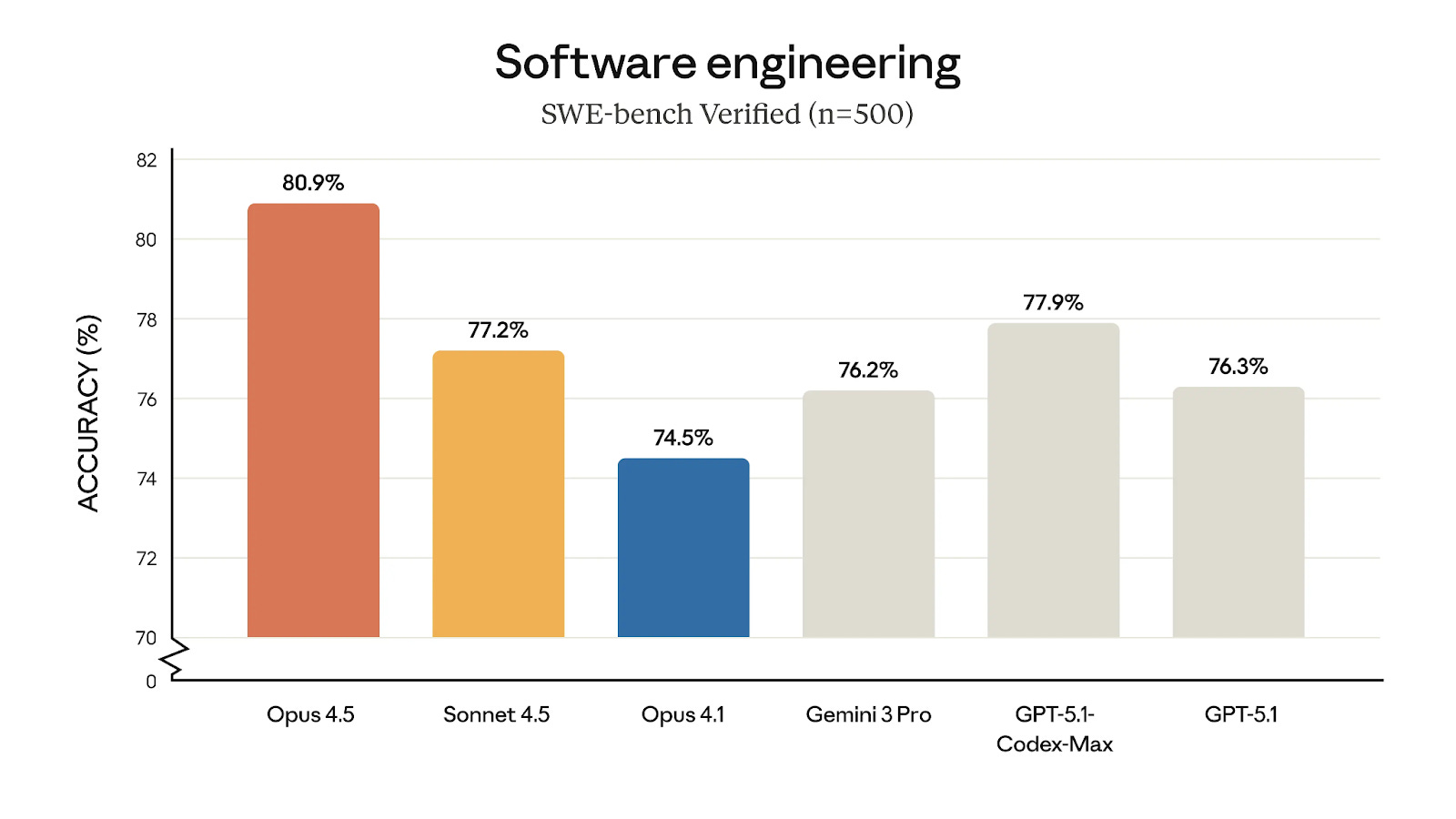
The article linked above gives plenty of anecdotes from this time period of engineers reacting to the improvement in tools. I highlight one below, from the CTO of Vercel:
“It’s been a crazy holiday period:
I built 2 major open-source projects (One unreleased and one is a full implementation of a bash environment in TypeScript for use by AI agents)
I started writing a book
I fixed a bunch of other things
It’s a very different world now that we live in the Opus 4.5 world. The above would absolutely not have been possible without it. Opus + Claude Code now behaves like a senior software engineer that you can just tell what to do, and it’ll do it. Supervision is still needed for difficult tasks, but it is extremely responsive to feedback and then gets it right.
I don’t want to be too dramatic, but y’all have to throw away your priors. The cost of software production is trending towards zero.”
Where is the scarcity now?
In the SaaS era, scarcity was engineering talent. In the AI era, scarcity is judgment. Who can reason about complex enterprise problems? Who has the data? Who controls the workflow?
The companies worth backing in this era are not building SaaS on top of AI. They’re building the infrastructure, orchestration, and workflow layers that make AI deployable at enterprise scale. They’re experts at sprinting at problems and solving those problems with the best tools available to them. This may sound service-y, and yes, at times it is. Why should startups do service-y work? Historically, it’s been low-margin, grueling, and highly competitive with the traditional service providers.
Startups should do the service-y work because no one else can. Asking the legacy consultants to keep up with the pace of change in AI is like asking an elephant to dance. There will be giant new companies built on the back of rethinking the software model through the lens of customization.
The age of custom software is coming
As the marginal cost of building custom software approaches zero, organizations gain the ability to create systems tailored to their specific workflows rather than adapting to one-size-fits-all platforms.
An audience member from the aforementioned panel emailed me after our bearish SaaS discussion. She, head of transformation for a multi-billion-dollar publicly traded business, said: “We’ve invested in several large SaaS applications, and managing them is becoming increasingly complex and costly. As our needs grow, so does the number of tools we rely on, which makes integration and workflow efficiency more challenging.”
I told her to create custom software. I told her about the firms doing it. I introduced her to one of them: Ciridae.
The CEO, Jack Soslow’s, response to her problems: “Software industrial bloat, integration complexity, and workflow efficiency are exactly what we solve for.”
During the panel, I had boldly predicted that someone would be able to one-shot a CRM within 12 months, given the rate of improvement we’re seeing.
So I went home that weekend, and guess what I did? Built our new firm’s CRM.
I have zero training in computer science. Laughably, I barely passed my Information Systems class in undergrad business school. I do, however, have a fiancé who is a software engineer and helped me get set up with the right packages. As soon as he finished the set-up, which took about an hour, I was off to the races with my companion, Cursor.6
Everything in our custom CRM has been built with AI, and has required almost no help at all from my fiancé. Anytime I want something explained, I ask the agent. Anytime the agent asks me to do something, I say: Can you just do that from the CLI? If it can’t, I have it create dummy-proof steps that I can walk through. This methodology has allowed me to add an abundance of features that are personal to our needs, as well as an amazing integration with my note-taking system, Granola, through Zapier.
If I can create integrations with no help from an engineering professional, then I must wonder what AI can do in the hands of small, fast, technical teams. For them, the sky is the limit.
These are my initial thoughts from the first two months of the year. I can only imagine what we will learn over the rest of 2026. We have now just entered the lunar year of the Fire Horse, which refers to momentum, pace, and intensity.7 Many entrepreneurs I know feel these shifts and the resulting sense of urgency to act. This is why I left IBM Ventures and am working on something new. More to come on that and where we see specific opportunities very soon.
Meaning: a single version of Microsoft Office only had to be built once, and then it could be sold an infinite number of times with no cost to reproduce (or rebuild)
Meaning: there is no cost of initial production. Thank you to Acquired FM for inspiring me with this one. I went back to the transcript of Microsoft Episode 1, and not only was I able to remind myself of where I first heard reproducibility as a concept discussed, but I also found Bill’s prescient quote on technology multiples, which I reference several lines later. If anyone reading this somehow knows David or Ben, please pass along my gratitude.
Monday, February 2rd, the week of the trillion dollar SaaS selloff
Though it, of course, attracted many early adopter engineers, as we saw Cursor’s revenue balloon in 2025, from ~$100M to $1B
I’ve since switched to Codex (they’re offering very high rate limits right now and my fiancé was insistent on 5.3’s superiority), but I actually liked Cursor quite a bit